


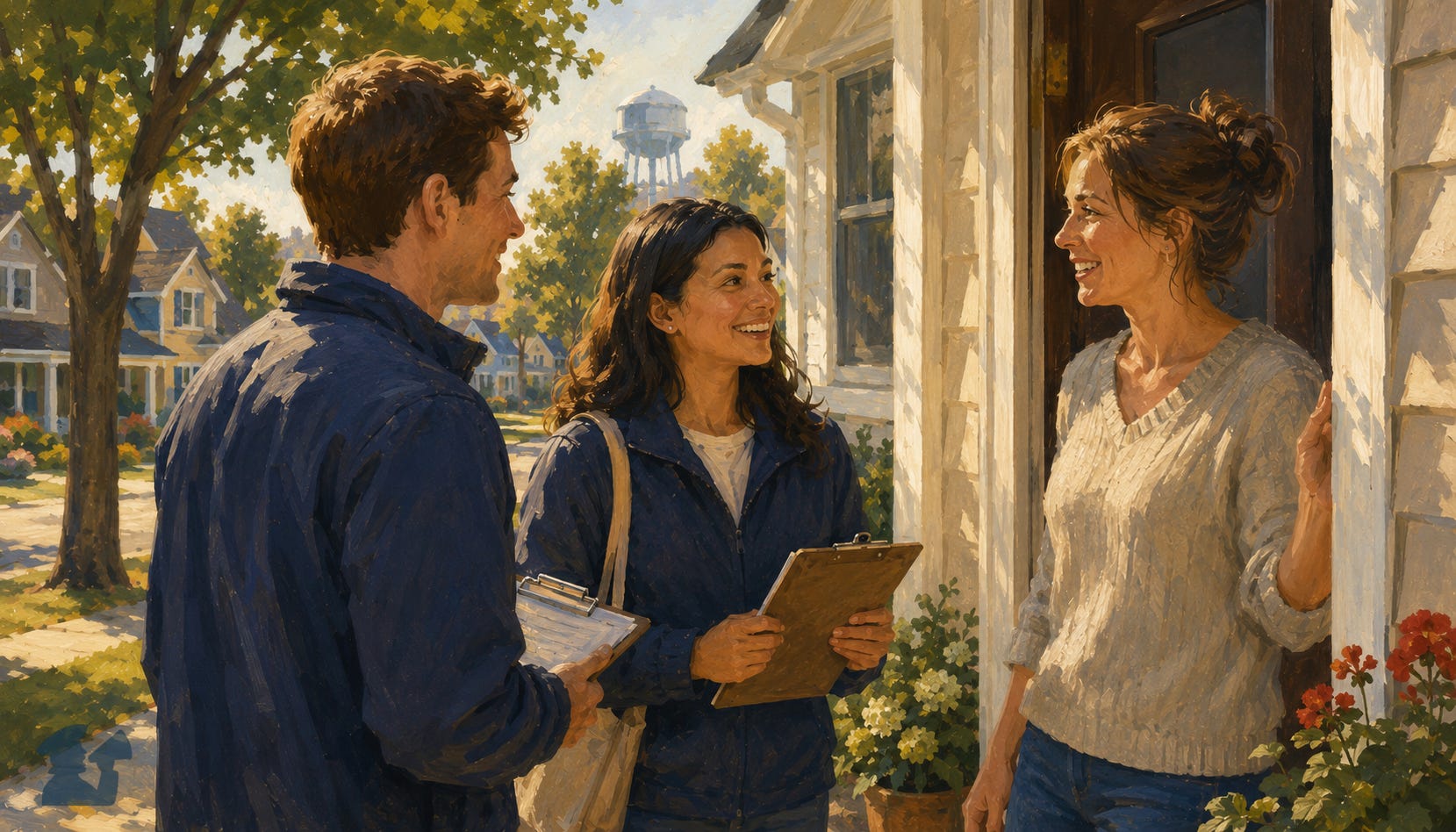
The Most Important Door You’ll Knock This Year Is the One You Knock in June
Here’s a number that should change how you think about the next six months: 387.
That’s how many votes separated Matt Little from his opponent in 2016, when he won a state Senate seat in a district Donald Trump carried by roughly seventeen points. Three hundred eighty-seven neighbors. Fewer people than show up to a decent farmers market on a Saturday morning.
State Senate and House races are won and lost in margins that thin. And the thing that moves those margins isn’t the thirty-second ad you’ll be sick of by October.
It’s door knocking (and shouldn’t it be called door belling by now?) It’s a person standing on a porch, talking to another person.
That person could be you. The question is when you decide to start.
The science is settled, and it’s not subtle
For twenty-five years, political scientists have been running actual randomized experiments on what gets people to vote, the same way a doctor tests a drug. The founders of that work, Alan Gerber and Donald Green at Yale, knocked on tens of thousands of doors in New Haven in 1998 and measured the result against a control group.
Door knocking won. It wasn’t close.
Their findings [PDF], published in the American Political Science Review, became the standard reference for every serious campaign in the country. Face-to-face canvassing raised turnout by about six points overall, and by nearly nine points among the people a volunteer actually reached at the door.
Phone banks did less.
Mailers did less.
Email did almost nothing.
When researchers later pooled fifty-one of these door-knocking experiments together, the verdict held: roughly a 4.3 percentage-point bump in turnout among people contacted in person. Gerber and Green put it plainly in their handbook Get Out the Vote: a face-to-face conversation produces about one additional vote for every fourteen doors knocked.
Fourteen doors. One vote. Do that math against a margin of 387 and you start to see why the people who knock decide who wins.
Why October is too late
Here’s the part most people get backward.
The instinct is to wait. The election’s in November, so you’ll help in the fall, when it “matters.” Save your energy for the big push.
The research says that instinct is wrong, and it says so with unusual force.
In 2018, researchers Joshua Kalla and David Broockman analyzed forty-nine separate field experiments to find out when campaign contact actually changes minds. Their conclusion was sobering for anyone planning a last-minute blitz. Persuasion in the final stretch of a general election is, on average, almost nil. But there was an exception, and it’s the whole ballgame:
“When campaigns contact voters long before election day... campaigns often appear to persuade voters. However, this early persuasion decays before election day and the very same treatments usually cease working close to election day.”
Read that again. The conversation that changes a neighbor’s mind has to happen early. Knock on that same door in late October and you’ve missed the window.
There’s a deeper reason this works. The most durable persuasion doesn’t come from a script and a flyer. It comes from a real conversation, ten or fifteen minutes long, where a volunteer listens as much as talks. Broockman and Kalla showed in a study published in Science that one such conversation could shift someone’s views for months. But you cannot have a thousand fifteen-minute conversations in the last week of October. You build that, door by door, starting now.
Mobilization adds up. Start the pile early.
Persuasion is only half the job. The other half is turnout, getting the people who already agree with you to actually fill out the ballot.
Here the lesson is about accumulation. When researchers Ryan Enos and Anthony Fowler studied the massive 2012 ground campaigns, they found something campaigns dream about: “no evidence of diminishing marginal returns.” Every contact, each one small on its own, stacked on the last. Together they raised turnout by seven to eight points in the states where the work got done.
A campaign isn’t a fireworks finale. It’s a savings account. The deposits you make in June compound through November.
And there’s a quieter return on starting early that no spreadsheet fully captures: the volunteer who knocks a few doors in June becomes the team leader in August who trains four new neighbors in September. That’s how a campaign grows the army it needs for the final weekend. Wait until fall and there’s no time left to build it.
This is the work, and it’s down the street
We’ve watched this play out right here in the southwest metro.
The Minnesota Senate has flipped on a single seat twice in recent memory, in 2016 and again in 2022, and was held by a hair in the 2024 special election out in Lake Minnetonka, where one race, the only Senate seat on the ballot, decided whether control of the chamber would flip. One district. The whole state hung on it.
Down-ballot races are exactly where a knock on the door counts most. In a presidential year, voters drown in contact. In a state Senate or House race, a volunteer at the door might be the only campaign anyone in that household ever talks to. The research bears this out: personal contact does more in quiet, low-information races than in the loud ones at the top of the ticket.
So the seat is winnable. The margin will be thin. And the person who moves it is a neighbor on a porch, in daylight, in summer. It could be you.
What to do, and when to do it
Don’t wait for October. Here’s the path:
Sign up now. Knock your first doors this summer, while the conversations can still change a mind and while there’s time to learn the work.
Bring someone. The neighbor you recruit in June is the team leader the campaign needs in September.
Come back in the fall for the turnout push, when reminding our people to vote is the whole job, and do it knowing you helped build the operation that makes that final weekend possible.
Your Senate or House district race needs door knockers, and it needs them now, not in the panic of the last few weeks. An afternoon you give in June is worth more than the same afternoon in October. That’s not a pep talk. That’s what the data says.
Three hundred eighty-seven votes.
Some summer Saturday, on some street near you, a few of those votes are waiting behind a door nobody’s knocked on yet.
Go knock.
The Politics Chicks In Real Life Event
I wrote previously about the importance of political campaign donations and how you can take advantage of Minnesota’s excellent Political Contribution Refund program. Well, here’s a fun fundraiser:

Tomorrow, the hosts of the extremely popular Minnesota politics podcast, The Politics Chicks, are hosting a live conversation and audience Q&A with District 48 Senate candidate, Dan Kessler. This event doubles as a fundraiser for his campaign. Doors open at 6:30. Register here.
Chaska Protests
Every Friday from 3:00–4:00 p.m. at the corner of Chaska Blvd. and Chestnut Street (Highway 41) [Map]
Every Saturday from 1-2 pm at the corner of Hazeltine Boulevard and Highway 41 (Chestnut) [Map]
Chanhassen Protests
Every Saturday from 10-11 am at 7700 Market Boulevard [Map] Public parking is available behind City Hall.
Norwood Young America
Every Sunday, 11 a.m.–12 p.m. (Line up at the bike path south of Highway 212 and Faxon.)
Victoria
Every Wednesday from 4:30-5:30 pm on the corner of Highway 5 and Victoria Drive/County Rd 11.
Waconia
Every Saturday from 11:30-12:30 pm at Highway 5 and County Road 10 in front of the Starbucks and Jersey Mike’s. [Map]
SW Protectors
Every first and third Tuesday from 6:30 – 8:00 pm. It’s no cost and come and go as you like.
Please do buy something to eat or drink, though, to support our venue, which is The Bellows restaurant and it’s located at 232 Pioneer Trail in Chaska.
Great article! I have heard similar information about the power of doorknocking but had not heard all these important details. Good to know that knocking in June is more effective and impactful than knocking in October.
I am out knocking doors in my house district practically every single day of the week. It has been a great opportunity to literally meet people where they are at. Thanks for the additional boost of inspiration.
Thanks for sharing the research links about the timing of political campaign persuasion and the effectiveness of door to door canvassing (which I have been doing already in House District 45A for Tracey Breazeale). I will give you the sincerest form of flattery by imitating your example, looking up some of the research and posting it in my Minnetonka Protest Memo (a newsletter that was inspired by the example of your SW Crier newsletter). Thanks.