


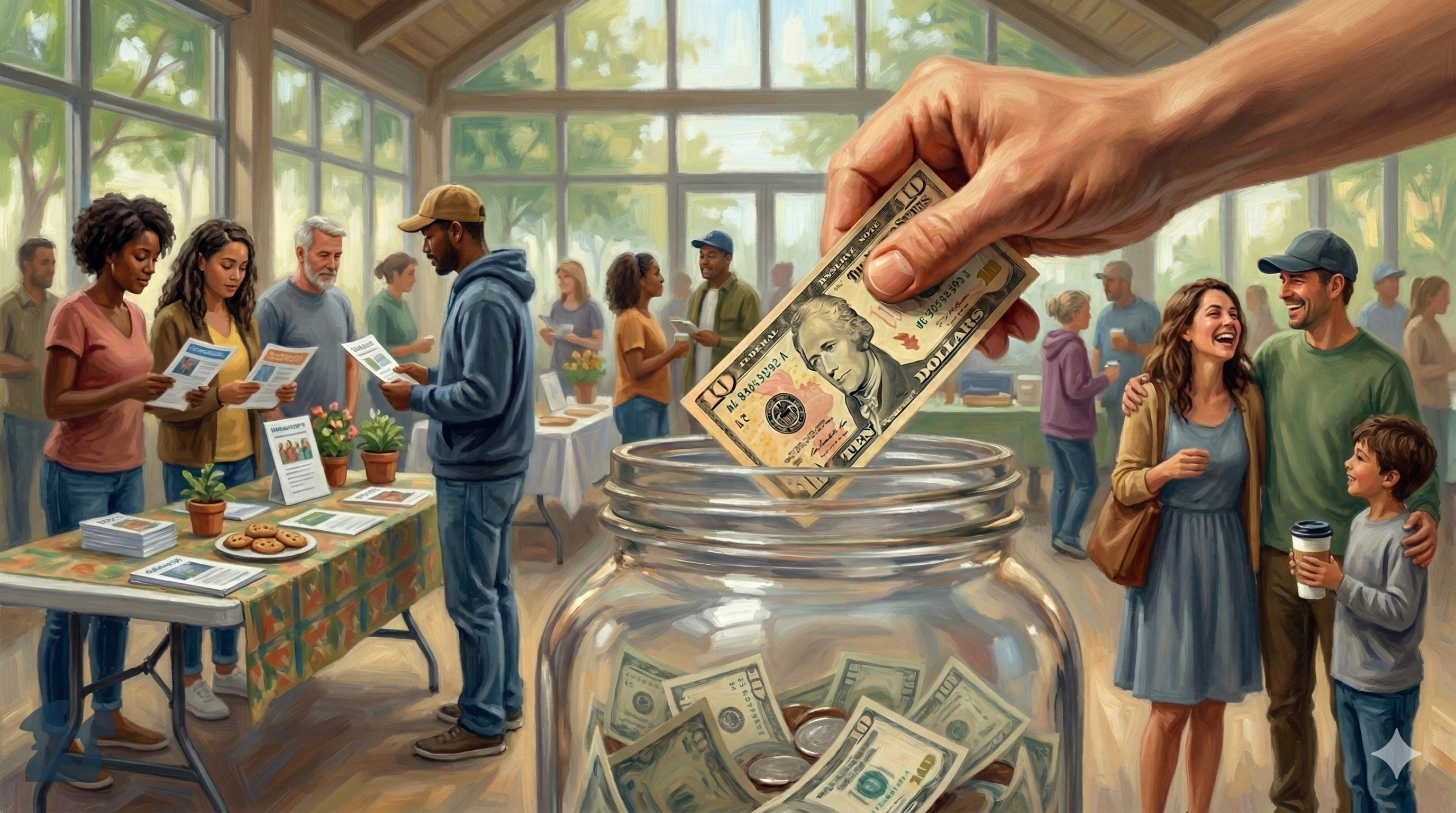
Most of us don’t think of ourselves as political donors. That word conjures something we’re not: A wealthy person writing a check at a fundraiser, shaking hands with a senator in a hotel ballroom. Someone with access we’ll never have.
But here’s what’s actually true. A $10 donation to a candidate you believe in does something that money can’t fully explain.
It gets counted.
In 2019 and 2020, the Democratic National Committee required presidential debate candidates to hit specific donor thresholds before they could take the stage.
Not dollar totals. Donor counts.
They started at 65,000 unique donors and scaled up to 225,000. The party made a formal, institutional decision that the number of real people who gave, even small amounts, was a legitimate measure of whether a candidate deserved to be taken seriously.
That policy reflected something researchers have documented for years. Political scientist Danielle Thomsen’s 2025 book The Money Signal found that the top fundraiser wins 92% of the time in congressional primaries and general elections.
Not because money buys votes. But because money is a signal: Journalists cover it, donors follow it, and party leaders use it to decide who gets support. A strong fundraising report generates media attention, which generates more donors, which generates more attention. The cycle runs both directions.
Here’s the thing: Self-funded money doesn’t trigger that cycle the way donor money does. Michael Bloomberg spent $1 billion of his own fortune on his 2020 presidential campaign and won zero primaries. Research confirms what Bloomberg’s campaign made impossible to ignore: Voters interpret donations from real people as evidence of real support in a way that personal wealth simply cannot replicate.
So when you give $10 to your city council candidate or your state legislator, you are not just funding a mailer. You are registering your existence as a constituent. You are adding your name to the count that reporters will look at when they decide whether a race is worth covering. You are one of the signals.
That matters especially in local and state races, where the difference between winning and losing can be a few hundred votes, and where a candidate can hit their fundraising threshold without a single megadonor involved.
The scale of what money buys at the top is genuinely staggering. In the 2024 cycle, one donor, Elon Musk, contributed more than $290 million, roughly equivalent to the combined donations of 3 million small-dollar Americans. The top 100 donors outspent millions of grassroots contributors by 60%. This is the landscape we’re operating in.
We can’t match those dollars. But we can change the signal.
Pew Research Center data shows that among Americans who nearly always vote, 21% also donate. Those who follow government closely donate at a rate of 28%. Donating is what engaged citizens do. It deepens the connection. It makes you more likely to put up a yard sign, knock a door, and show up in November.
70% of donors, according to a Bipartisan Policy Center audit [PDF], describe their contributions as “obligated by civic duty,” not as a transaction.
That’s the right frame.
Not investment.
Duty.
The candidates running for your school board, your state house seat, your county commission, they need small donors. Not just for the money. They need the donor count. They need proof that their neighbors are paying attention and choosing to back them up.
Find someone you believe in. Give what you can. Even $10 counts.
It always gets counted.
To find candidates in the Southwest Metro, check the SD48 DFL endorsements or visit mn.gov/sos for your local races. Your contribution is reported publicly once it crosses $200 in aggregate, so small donors have privacy most large donors do not.
Next week, I’ll publish an article about how you can take advantage of Minnesota’s Political Contribution Refund (PCR) program.
David
Chaska Protests
Every Friday from 3:00–4:00 p.m. at the corner of Chaska Blvd. and Chestnut Street (Highway 41) [Map]
Every Saturday from 1-2 pm at the corner of Hazeltine Boulevard and Highway 41 (Chestnut) [Map]
Chanhassen Protests
Every Saturday from 10-11 am at 7700 Market Boulevard [Map] Public parking is available behind City Hall.
Waconia
Every Saturday from 11:30-12:30 pm at Highway 5 and County Road 10 in front of the Starbucks and Jersey Mike’s. [Map]
Norwood Young America
Every Sunday, 11 a.m.–12 p.m. (Line up at the bike path south of 212 by Reform Street.)
SW Protectors
Every first and third Tuesday from 6:30 – 8:00 pm. It’s no cost and come and go as you like.
Please do buy something to eat or drink, though, to support our venue, which is The Bellows restaurant and it’s located at 232 Pioneer Trail in Chaska.
David, regarding shielding contributions from public view - isn't that what Citizens United is all about?
David, thank you! Good to know there are good reasons for us to make even small donation!