


Most Minnesotans have never heard of the Political Contribution Refund program.
That’s a shame, because it’s one of the most useful civic tools in the state, and almost nobody talks about it.
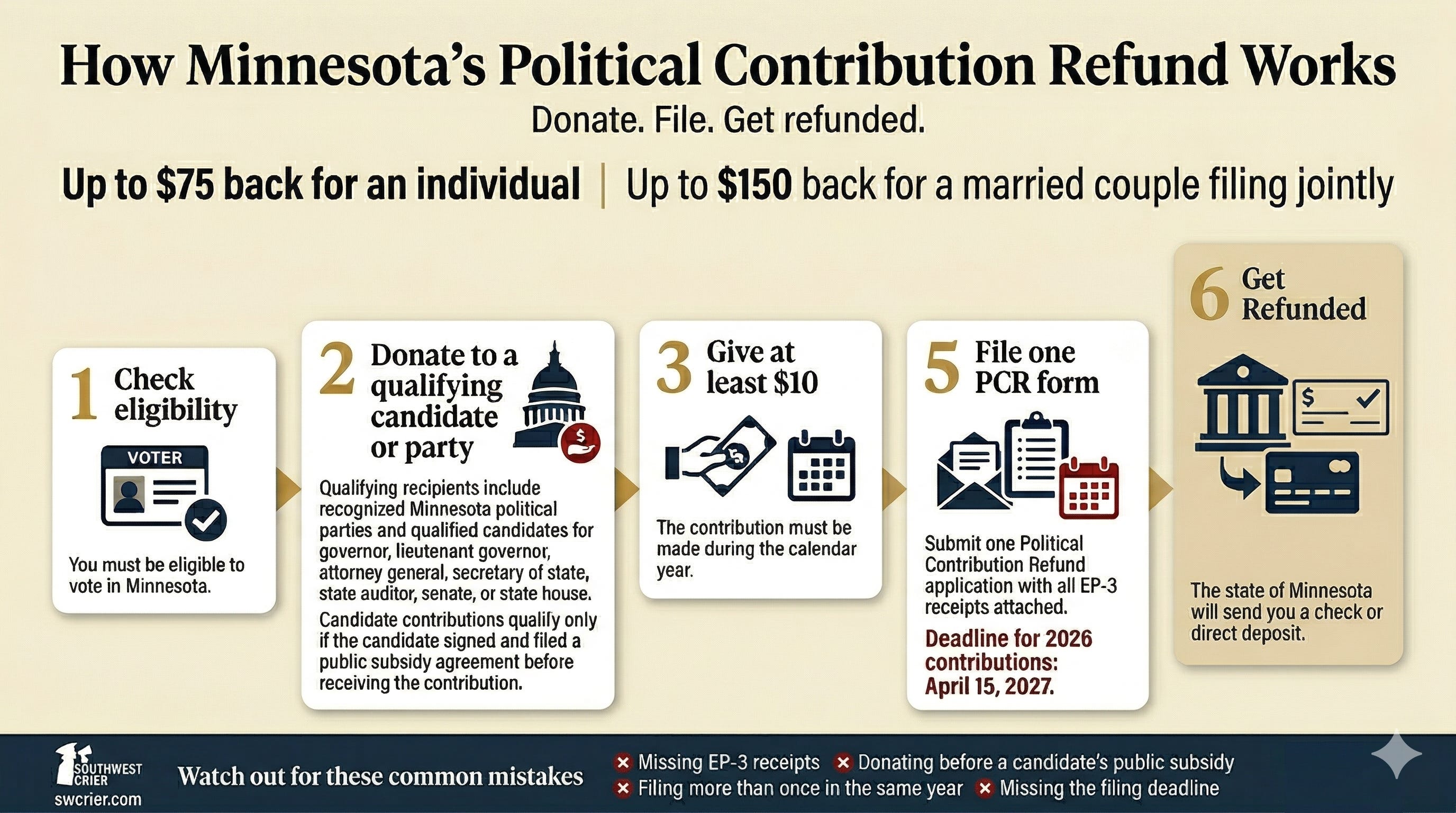
Here’s the short version: if you donate to a qualifying Minnesota state candidate or political party, the state will send you your money back. Up to $75 for an individual. Up to $150 for a married couple filing together. Dollar for dollar.
You pay $50 to a state senate candidate you believe in. The state of Minnesota sends you $50.
That’s it. That’s the program.
Now let’s walk through how it actually works, step by step, so you can use it.
Who qualifies to claim the refund?
You need to be a U.S. citizen, at least 18 years old, and a Minnesota resident. Specifically, you need to have lived in Minnesota for at least 20 days before any 2026 statewide or local election in which you’d be eligible to vote. You also need to be a registered voter or eligible to register.
If a court has rescinded your right to vote, or you have a felony conviction with civil rights not yet restored, you’re not eligible. Otherwise, if you can vote in Minnesota, you can almost certainly use this program.
Which candidates and parties qualify?
This is the part that trips people up, so pay attention.
The PCR program only applies to contributions made to Minnesota state-level candidates and recognized political parties. Specifically: Governor, Lieutenant Governor, Attorney General, Secretary of State, State Auditor, and members of the Minnesota State Senate and House of Representatives.
That’s it.
Federal candidates (your U.S. senator, your U.S. representative, anyone running for president) do not qualify. Judges do not qualify. Your city council member, county commissioner, school board candidate; none of them qualify.
Political party units do qualify. The DFL, the Republican Party of Minnesota, and several others are eligible, right down to precinct and legislative district units, as long as they’re properly registered.
PACs and independent political funds do not qualify.
The other critical requirement: the candidate must have signed a Public Subsidy Agreement (PSA) with the Minnesota Campaign Finance and Public Disclosure Board before you donate. This is a voluntary pledge by the candidate to accept spending limits in exchange for participating in the PCR program. Most serious campaigns file this early. If they haven’t filed it yet when you donate, your contribution won’t be refundable, even if they file it later.
Before you give to any state candidate, ask the campaign: “Are you PCR-eligible?” Or check the Campaign Finance Board’s website at cfb.mn.gov. This one step will save you a headache.
Step by step: how to get your money back
Step 1. Donate. Make a cash, check, or credit card contribution of at least $10 to a qualifying candidate or party unit. In-kind donations (your time, your stuff) don’t count. Only money.
Step 2. Get your EP-3 receipt. After you donate, the campaign is legally required to send you a Form EP-3 (Minnesota Political Contribution Receipt). This is the document that proves you gave. It must be signed by the candidate, the campaign treasurer, or an authorized party official. Many campaigns mail these; some email them. If you don’t receive one within a few weeks of donating, contact the campaign and ask for it.
Step 3. Wait until you have all your receipts for the year. Here’s an important rule: you can only file one PCR application per year. If you donate to three different candidates, collect all three EP-3 receipts and file them together in a single application. Filing a second application for the same year will get your second claim denied, regardless of how much you’ve already claimed.
Step 4. Fill out the 2026 Form PCR. This is a short form. You’ll need your name, mailing address, Social Security Number, and date of birth. Attach all your EP-3 receipts. Sign it. (Married couples filing jointly need both signatures.)
The form is available at revenue.state.mn.us/political-contribution-refund.
Step 5. Mail it to the Minnesota Department of Revenue. The address is on the form. That’s all. No filing fee. No complex tax math.
Step 6. Get paid. The Department of Revenue typically processes claims in 4 to 6 weeks. If you choose direct deposit on Line 4 of the form (routing number, account number), you’ll get your money faster.
When do you file?
You can file as soon as you have your EP-3 receipt in hand, even in January. You don’t have to wait for tax season.
The final deadline to file for 2026 contributions is April 15, 2027. No extensions. And you can’t amend an application once it’s filed, so get it right the first time.
Pro tip: file in the summer or fall, not in April. The Revenue department processes claims faster when they’re not buried in end-of-season applications.
Common mistakes that get claims denied
Don’t use a nickname on the PCR form if your EP-3 has your legal name. The state’s automated systems flag name mismatches.
Don’t file twice in the same year. One application, with all your receipts attached.
Don’t forget to sign.
Don’t get the Social Security Number wrong.
Don’t donate to a candidate before they’ve signed their PSA.
One more thing: this program may not exist next year
Two bills in the current legislative session (SF3458 and HF3149) would repeal the PCR program entirely, with some versions taking effect as soon as June 30, 2026. Nothing is final as of this writing, but the program is under real political pressure.
If the PCR matters to you, this may be the last year to use it. And if you want to keep it, there are advocacy organizations calling for public support at actionnetwork.org/letters/support-the-minnesota-political-contribution-refund.
Bottom line
Minnesota built a program specifically to make it easier for regular people to participate in state politics. You donate to a candidate you believe in. The state gives you your money back. In a world where billionaires can spend $290 million on a single election cycle, this is how your voice gets to register on equal terms.
Use it.
Get your EP-3. Fill out the form. Mail it in.
And if you’re supporting a state candidate in the Southwest Metro this year, make sure they’re PCR-eligible before you give. The candidates who’ve signed their agreements are ready for your support and the state is ready to pay you back for it.
David
Chaska Protests
Every Friday from 3:00–4:00 p.m. at the corner of Chaska Blvd. and Chestnut Street (Highway 41) [Map]
Every Saturday from 1-2 pm at the corner of Hazeltine Boulevard and Highway 41 (Chestnut) [Map]
Chanhassen Protests
Every Saturday from 10-11 am at 7700 Market Boulevard [Map] Public parking is available behind City Hall.
Waconia
Every Saturday from 11:30-12:30 pm at Highway 5 and County Road 10 in front of the Starbucks and Jersey Mike’s. [Map]
Norwood Young America
Every Sunday, 11 a.m.–12 p.m. (Line up at the bike path south of 212 by Reform Street.)
SW Protectors
Every first and third Tuesday from 6:30 – 8:00 pm. It’s no cost and come and go as you like.
Please do buy something to eat or drink, though, to support our venue, which is The Bellows restaurant and it’s located at 232 Pioneer Trail in Chaska.
This is a terrific post. Thanks David!
Great information!