


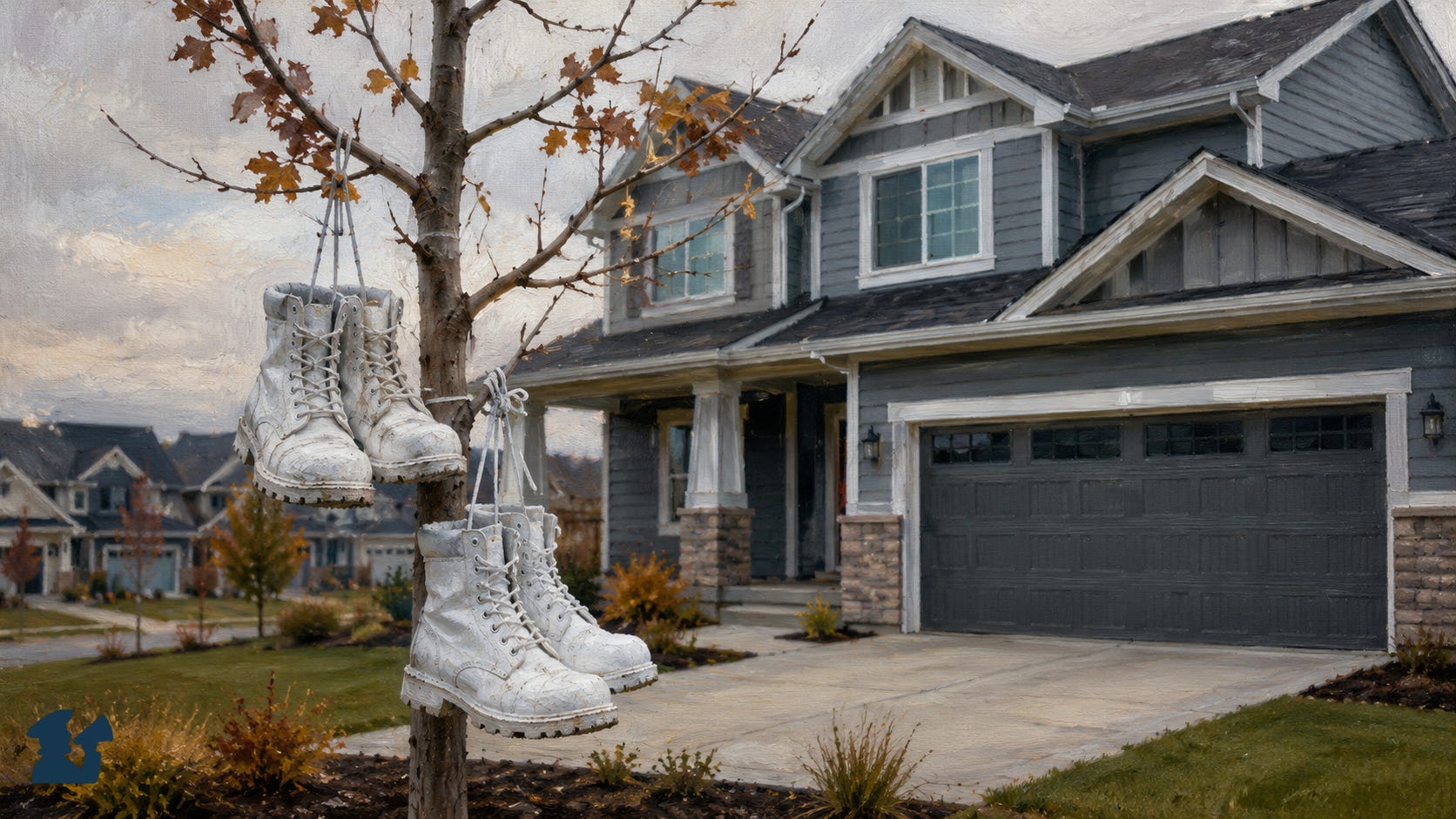
I’ve been meaning to share this story about the Ghost Shoes project with you all.
Volunteers have installed 50 pairs of white shoes at locations throughout Minneapolis where ICE abducted people, the Star Tribune’s Alicia Eier reports.
On a fence at Valley View Elementary School in Columbia Heights, four pairs of small white shoes hang in a row. Kid-sized. Painted bone-white. No feet inside them.
One of those pairs belongs to Liam Ramos, the five-year-old boy who was detained alongside his father, Adrian Alexander Conejo Arias, by federal agents on January 20 at that approximate spot. You may remember the story. It drew international attention.
The shoes are still there.
They were hung by Anthony Marchetti, 47, of Minneapolis, and his son Luciano, 8. “We don’t want people to forget,” Anthony told the Star Tribune. “We want people to remember and to continue to fight injustice.”
Multiply that fence by fifty.
What the project is
The project is called ICE Ghost Shoes 26: A Remembrance, conceived by Minneapolis artist Laura Migliorino. Fifty pairs of white-painted shoes now mark Twin Cities locations where federal agents detained, shot, killed, or committed violence against someone during Operation Metro Surge. Each pair carries a tag with the date, a short description, and a QR code linking to @ghostshoesice26 on Instagram.
The project draws on a deep tradition: the Shoes on the Danube Bank in Budapest, the Stolpersteine plaques set into European sidewalks for deported Jews, the ghost bikes chained to telephone poles where cyclists were killed.
This is what civic art has always been for.
The next phase: installations across the rest of Minnesota, starting in July.
That includes here.
The Southwest Metro is not exempt
It would be easy, reading the Strib piece, to assume Operation Metro Surge happened somewhere else. Lake Street. North Minneapolis. The cities. Someone else’s neighborhood.
We know otherwise.
Federal agents operated in Eden Prairie. In Chanhassen. In Chaska. In Shakopee. Out at the construction sites and the auto shops and the cleaning company parking lots that keep this metro running. They sat in unmarked vehicles outside apartment complexes off Highway 5. They followed people home from second-shift jobs on Highway 41. Neighbors of yours watched it happen. Some of them stopped going to work. Some stopped going to church. Some are still gone.
If you have neighbors who were detained.
If you drive Highway 7 to work, you have driven past locations that belong on this map.
The shoes haven’t gone up here yet. They could. They should.
How you can help
Here is what we know about getting involved, based on what Migliorino and the organizers have said publicly:
Add a location. The project’s installation map is built from ICEout.org. If you witnessed an enforcement action in the Southwest Metro, or if you know of one that happened to someone in your neighborhood, you can add it to the map. The team is actively looking for sites in the rest of Minnesota for the July expansion.
Donate shoes. The project transforms donated footwear into ghost shoes by painting them white. Adult shoes, kid shoes, work boots. Anything that fits the foot of a real person who walked our streets.
Paint. Volunteers do the painting in groups. It is slow, deliberate work, and it is also community work. You meet people who care about the same things you do.
Install. Ten different groups of volunteers installed the first fifty pairs. When the project reaches the Southwest Metro, those installation teams will need people who know which fence, which signal pole, which stretch of sidewalk matters and why.
Follow and share. The project’s Instagram is @ghostshoesice26. Every QR code on every pair of shoes points back there. The more people who follow, the more the documentation travels.
Why this matters now
The administration would like Operation Metro Surge to fade. They would like the chaotic footage to slip out of the news cycle. They would like the kids who were taken from school pickup lines to become a story other people tell, somewhere else, about another time.
The shoes are how we refuse that.
Every pair on a fence is a small public sentence: Someone stood here. Federal agents came. We saw it. We will not let it disappear into the regular noise of the day.
That sentence belongs in Eden Prairie. It belongs in Chaska. In Shakopee. It belongs at the intersections you turn through on your way to soccer practice, because that is precisely where the people who do the work of this metro were targeted.
We have a chance, between now and July, to make sure the Southwest Metro is on the map when the next wave of installations begins.
If you witnessed an enforcement action in our area, or you know someone who did, report it to ICEout.org so the location gets on the installation map.
A pair of small white shoes on a fence is not much. It is also everything. It is the thing that says, decades from now, when someone walks their kid past that spot: This happened here. We remembered. We did not look away.
That memory is ours to build.
The Symbolic Power of Shoes
If you have seen Jojo Rabbit, you already know why shoes carry this kind of weight. (Spoiler alert: If you haven’t seen that superb film, you might want to watch it first before reading the rest of this.)
Taika Waititi’s film follows a ten-year-old Hitler Youth recruit whose mother, Rosie, is secretly a member of the German resistance. We meet her shoes before we meet her face. The camera lingers on them, red and white, as she walks. Rosie ties Jojo’s laces over and over throughout the film. It is her small, stubborn act of love.
And then, late in the film, Jojo turns a corner in the town square and sees a pair of red and white shoes hanging above the cobblestones. The shoes are how he learns his mother has been hanged by the Gestapo. The camera holds on the shoes, not the body.
It is one of the most devastating images in modern cinema, and it works precisely because Waititi understood what every memorial artist understands: a shoe is the last honest record of a person. It holds the shape of who they were. It says they walked here, stood here, lived here.
At the end of the film, Jojo finally manages to tie a pair of shoes himself, the red ones, now on the feet of Elsa, the Jewish girl his mother hid. He has grown up. He has chosen humanity. The shoes carry that, too.
This is what the Ghost Shoes are doing on our fences. They are not abstractions. They are the shape of a neighbor who was here.
See you all tomorrow!
David
Chaska Protests
Every Friday from 3:00–4:00 p.m. at the corner of Chaska Blvd. and Chestnut Street (Highway 41) [Map]
Every Saturday from 1-2 pm at the corner of Hazeltine Boulevard and Highway 41 (Chestnut) [Map]
Chanhassen Protests
Every Saturday from 10-11 am at 7700 Market Boulevard [Map] Public parking is available behind City Hall.
Norwood Young America
Every Sunday, 11 a.m.–12 p.m. (Line up at the bike path south of Highway 212 and Faxon.)
Victoria
Every Wednesday from 4:30-5:30 pm on the corner of Highway 5 and Victoria Drive/County Rd 11.
Waconia
Every Saturday from 11:30-12:30 pm at Highway 5 and County Road 10 in front of the Starbucks and Jersey Mike’s. [Map]
SW Protectors
Every first and third Tuesday from 6:30 – 8:00 pm. It’s no cost and come and go as you like.
Please do buy something to eat or drink, though, to support our venue, which is The Bellows restaurant and it’s located at 232 Pioneer Trail in Chaska.
I would love to be involved in this. I could donate some shoes, paint some shoes and install shoes with a group. I followed on Instagram, but let me know how I can get involved. And THANKYOU!
Thank you, David, for your meaningful comments today. Your column was the best piece I read all week because of the way you crafted it and included us. Your words will stay with me for a long time. Thank you very much for taking the time and energy to write--always, but this column in particular.