


The Emmers Have A New Family Business
In 1910, Tom Emmer’s great-grandfather and two of his brothers opened a lumber company. Emmer Brothers Lumber is still around, employee-owned now and doing business as Viking Forest Products.
The family has a different line of work these days.
It’s Congress.
Start with the man at the top. Tom Emmer has represented Minnesota’s 6th District since 2015. He ran the House Republicans’ campaign arm for two cycles, and since January 2023 he’s been House Majority Whip, the third-ranking Republican in the chamber. His job is counting votes and making sure his members cast them the way leadership wants.
Then there’s his son. Jack Emmer started on Capitol Hill in 2017 as a staff assistant to a Florida congressman, at about $33,000 a year. In February 2023, a few weeks after his father became whip, he was hired as counsel on the House Oversight Committee. In 2025 he took a short detour to the U.S. Department of Transportation, working in the general counsel’s office under Secretary Sean Duffy. By November 2025 he was back at Oversight as chief counsel for investigations. Congressional salary records show the committee paid him $108,000 in the first six months of 2026.
Then there’s his daughter-in-law. Kelsey Emmer, who married Jack in 2023, is communications director for Rep. Pete Stauber, the Republican who represents northeastern Minnesota’s 8th District.
One family. Three offices. All of them driving in the same direction.
Watch How The Pieces Fit
In March, Tom Emmer was temporarily added to the Oversight Committee so he could question Gov. Tim Walz and Attorney General Keith Ellison about fraud in Minnesota’s safety-net programs.
In June, the committee’s Republican majority staff released a 205-page report on the fraud. The transcripts show Jack Emmer questioning Minnesota officials and sitting in on interviews with other state officials. His father called the report a “BOMBSHELL investigation” and promoted it relentlessly. According to The Politics Chicks, he never once mentioned his son had been in the room.
After the report came out, Tom Emmer, Pete Stauber and two other Minnesota Republicans signed a letter calling on Walz and Ellison to resign. Stauber’s communications director is Kelsey Emmer. The report mentions none of these relationships.
Three members of one family. Three talking points in one investigation.
The same committee, with the same chief investigator, has also been working through the Jeffrey Epstein files. Jack Emmer opened and conducted the transcribed interview of former U.S. Attorney General Pam Bondi, and he was among the staff handling Bill Clinton’s deposition. On that investigation, as a Minnesota Reformer commentary pointed out, his father has had nothing to say at all.
To be fair, nothing here appears to violate the federal anti-nepotism rule. It bars members of Congress from hiring relatives onto their own staffs or onto committees they chair, and Tom Emmer doesn’t chair Oversight. The committee’s chair, Rep. James Comer, is the one who signs Jack’s paychecks. And nothing in the public record shows anyone put a thumb on the scale.
The rules were written for a cruder kind of nepotism, the congressman who puts his kid on the payroll. They weren’t written for a House where committee chairs depend on leadership for their budgets, their floor time and their futures. In that world, the whip’s son doesn’t need his father to hire him. Everyone already knows whose son he is.
When politics becomes the family business, the question isn’t whether the paperwork is in order. It’s who the business serves.
Moving “Principles”
Politicians change their minds. That’s allowed; sometimes it’s even admirable. What stands out about Tom Emmer is the direction of travel. Over three decades, his positions have drifted toward wherever the power happened to be sitting at the time.
The St. Paul Years
Emmer got a DWI-related ticket at 20. In 1991, he pleaded guilty to careless driving after two DWI charges were dropped. As a state legislator, he later sponsored bills to shorten license revocations for people accused of drunk driving. When that history came up during his 2010 run for governor, he called it a matter of due process.
In isolation, it’s a fair argument that people shouldn’t have their license revoked absent a guilty verdict. In context, well, you can judge for yourself.
That same year, he floated a “tip credit” that would have let restaurants pay servers less than the minimum wage. His reasoning: With tips, some servers were “earning over $100,000 a year.” Minnesota servers answered at a town hall, where a protester dumped a bag of pennies on his table. “I have a tip for you too, Emmer!”
He also backed a state constitutional amendment that would have let Minnesota block federal laws the Legislature hadn’t approved. That’s nullification, an idea the courts buried long before any of us were born. Remember it; it’ll matter in a minute.
The Campaign Chief
As chair of the National Republican Congressional Committee, Emmer signed a 2019 fundraising letter claiming that George Soros, Tom Steyer and Michael Bloomberg had “essentially BOUGHT control of Congress for the Democrats.” Jewish community leaders here in Minnesota pointed out the obvious problem with a story about rich Jewish financiers secretly purchasing a government. Emmer didn’t retract it.
In October 2022, he posted a video of himself firing a gun at a shooting range, captioned “13 days to make history. Let’s #FirePelosi.” Days later, a man broke into Nancy Pelosi’s San Francisco home and fractured her 82-year-old husband’s skull with a hammer. On Face the Nation, anchor Margaret Brennan asked Emmer the obvious question: “Wouldn’t a pink slip be more fitting if it’s about firing her? Why a gun?” He kept the video up.
Then there’s crypto. In December 2021, Emmer praised FTX founder Sam Bankman-Fried at a hearing: “Sounds like you’re doing a lot to make sure there is no fraud or other manipulation.” In March 2022, he led eight House members in pushing back on the SEC’s informal inquiries into crypto firms, which were “stifling innovation.”
FTX was one of the firms receiving those inquiries. FTX employees gave Emmer’s campaign $11,600, and FTX money sent another $2.75 million to the House Republican leadership super PAC while he ran the party’s House campaigns. When FTX collapsed into one of the biggest frauds in American history, Emmer blamed the SEC.
The man who now says he’s fighting fraud once complimented one of the century’s great fraudsters on his fraud prevention.
The Loyalty Test
After the 2020 election, Emmer signed a brief supporting Texas’ lawsuit to throw out the results in four swing states. Then, on January 6, he voted to certify those same results, explaining that Congress had no authority to discard electors certified by a state. He was right. It was also the opposite of the position he’d signed his name to a few weeks earlier.
That vote cost him. In October 2023, House Republicans nominated Emmer for Speaker. Donald Trump went on Truth Social and called him a “Globalist RINO” who “never respected the Power of a Trump Endorsement, or the breadth and scope of MAGA.” Emmer withdrew the same day.
What came next is the most revealing part of his career. Within months, he was holding a Mar-a-Lago fundraiser with Trump and serving as Trump’s Minnesota campaign chair. By October 2024, Trump’s spokeswoman was calling him “a great man and a great ally to President Trump.”
Remember the nullification amendment? Where were his states rights principles when ICE came to terrorize his constituents and kill Minnesotans? He wasn’t merely silent, he egged them on.
The man who once wanted Minnesota to be able to veto federal law now spends his days making sure federal law says exactly what Trump wants it to say.
The Rhetoric Follows
A decade ago, Emmer called Somali Minnesotans one of “the fastest-assimilating populations” in the country. In June, at a Faith and Freedom Coalition event on Capitol Hill, he said this: “They don’t assimilate. And if they don’t assimilate, then they should go the hell back to where they came from.” Rep. Ilhan Omar’s reply was hard to improve on: “I assimilated all the way to Congress and this idiot still tells me to go back where I came from.”
Weeks earlier, delegates at the Minnesota GOP convention in Duluth had held a moment of silence for Derek Chauvin, the former police officer convicted of murdering George Floyd. Emmer defended them: “It’s a sad day in the State of Minnesota when it’s so-called ‘news’ that hundreds of patriotic Minnesotans came together to peacefully and respectfully recognize a member of law enforcement.”
A member of law enforcement. That’s what the party of law and order’s highest-ranking Minnesotan chose to call a man a Minnesota jury convicted of murder.
Put it all together and a pattern shows up. The principles aren’t the fixed point. The power is.
We Are Paying For His Loyalty
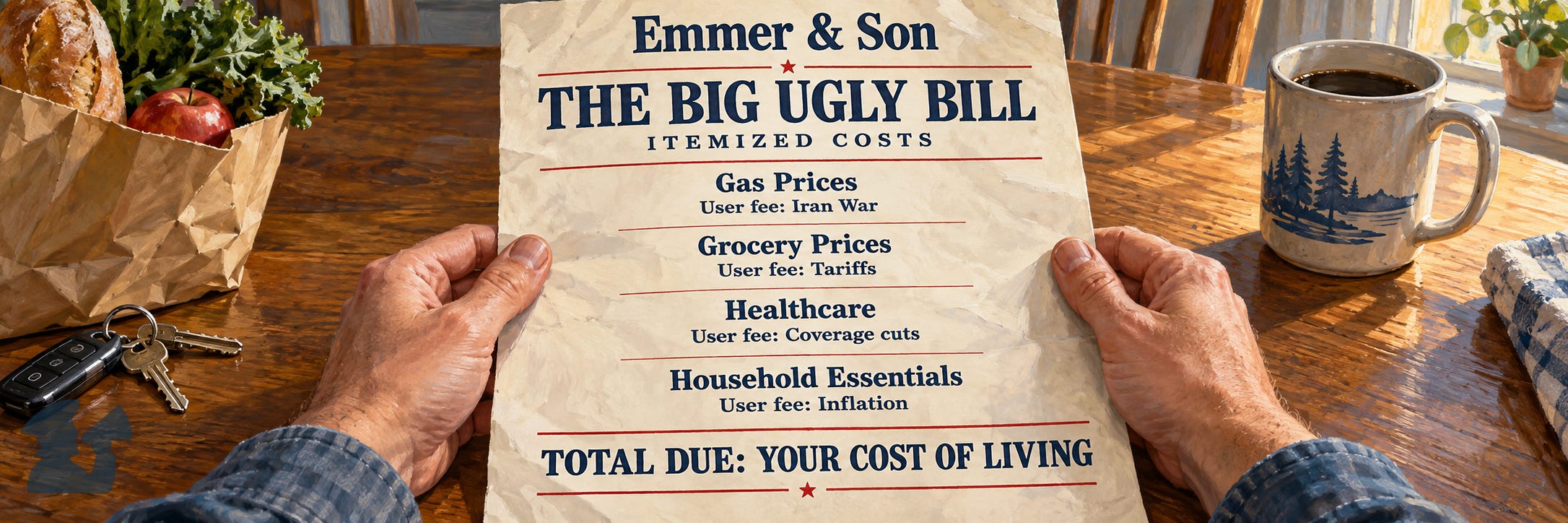
If you want to know what that loyalty is worth, look at the Big Ugly Bill.
A whip’s job is to deliver the votes, and Emmer delivered. The House passed the bill by the narrowest of margins, and Trump signed it on July 4, 2025. Emmer sold it the whole way. The bill was “all about making government actually perform for the people,” he said on ABC. A few weeks after it became law, he and the rest of Minnesota’s GOP delegation promised us that “nothing in our bill takes away health care” from single mothers, children, seniors or the disabled. Anyone who said otherwise, they wrote, was telling “lies to stoke fear.”
A year later, we don’t have to guess. We can count.
Health Care
The Minnesota Department of Human Services expects about 140,000 Minnesotans to lose Medicaid eligibility. Another 60,000 are likely to drop marketplace coverage as costs climb. The state stands to lose more than $2 billion in federal health care funding in fiscal year 2028 alone.
Those losses don’t come from a single dramatic cut. They come from paperwork. The law requires work reporting for adults without children, eligibility checks every six months instead of every year, new cost-sharing, and a shorter window for retroactive coverage. This spring, the Minnesota House had to pass a bill rewriting state law to match, on a 69-63 vote, because refusing would have put $3.5 billion to $4 billion a year in federal money at risk.
That’s the trick. Nobody sends a letter saying “your health care is canceled.” A mother working two part-time jobs misses a reporting deadline, or her hours dip one month, or the renewal form goes to an old address. She’s off the rolls. Multiply that by a hundred thousand and you get the number DHS is projecting.
It lands hardest where Emmer’s own voters live. Nearly half of Minnesota’s Medicaid enrollees live outside the Twin Cities metro. Rural hospitals depend on those Medicaid dollars to keep their doors open. The law’s consolation prize, a Rural Health Transformation fund, sent Minnesota $193 million in its first year, and hospitals are still waiting to see much of it. “It’s sort of like they’re in a boat that’s full of water, and somebody throws them an oar,” said Joe Schindler of the Minnesota Hospital Association. Rachelle Schultz, who runs Winona Health, put it more simply: The fund “doesn’t even come close.”
Groceries
More than 400,000 Minnesotans get SNAP benefits each month. Most are children, seniors and people with disabilities. The average benefit is about $6 a day.
Since the bill was signed, 18,000 Minnesotans have lost those benefits. The law also shifts costs onto the state: Minnesota now pays 75% of the program’s administrative costs instead of half, and it faces new penalties tied to its payment error rate. The Minnesota Reformer puts the new cost to the state at roughly $250 million over two years.
That money has to come from somewhere. It’ll come out of the next state budget, which means OUR schools, OUR roads, or OUR property taxes. Meanwhile, county workers are drowning in the new reporting rules. “They’re struggling to keep up,” State Auditor Julie Blaha said.
So here’s the math of the family business. A congressman from central Minnesota rose to the third-highest job in the House by learning to give Donald Trump whatever he wants. What Trump wanted was this bill. And the people paying for it are Minnesotans: the rural hospital, the county caseworker, the kid whose family lost its grocery help.
The Emmer Business Has A Customer. It’s us.
Tom Emmer isn’t some distant Washington figure to the southwest metro. For a lot of Southwest Crier readers, he’s our congressman. He’s mine. On November 3, voters in the 6th District will choose between Emmer and DFL nominee Doug Chapin of Hanover. Not sure which district you’re in? Look up your address at mnvotes.gov/pollfinder.
But here’s the thing about the whip’s job: It only exists in the majority. Emmer is whip because Republicans control the House. So even if you live outside the 6th, your vote matters here. Every House seat in Minnesota helps decide whether that stays true in January.
So does every seat in every state. A Congress that has to answer to someone other than Donald Trump is a Congress that can reopen the health care and food assistance cuts Minnesotans are living with right now.
The family business depends on one thing: Us not paying attention. So pay attention.
Vote early. In-person absentee voting is open now through November 2 at your county or city elections office. Find hours and locations at mnvotes.gov.
Register by October 13 to skip the line on Election Day. Missed it? Minnesota lets you register at your polling place with proof of residence.
Voting by mail? Apply at mnvotes.gov/absentee, get your witness, and send it back early. Then track your ballot to make sure it counted.
On Election Day, polls are open 7 a.m. to 8 p.m. Find yours at mnvotes.gov/pollfinder.
Then do one more thing. Call someone else who lives in the 6th District. A cousin in Buffalo, a friend in Elk River, a former coworker in St. Cloud. Ask whether they’ve made a plan to vote. Tell them about the rural hospitals. Tell them about the 18,000 Minnesotans who lost their grocery help.
The Emmers have spent a long time building their family business. It took more than a century to get from a lumberyard to the House leadership suite.
It only takes one election to remind them who they work for.
David
Chaska Protests
Every Friday from 3:00–4:00 p.m. at the corner of Chaska Blvd. and Chestnut Street (Highway 41) [Map]
Every Saturday from 1-2 pm at the corner of Hazeltine Boulevard and Highway 41 (Chestnut) [Map]
Chanhassen Protests
Every Saturday: 1st & 3rd Saturdays from 10-11am at Pedestrian Bridge over Highway 5.
Park at Discovery United Methodist Church. We have permission to park there.
2nd, 4th and 5th Saturday from 10-11am at W 78th and Kerber Boulevard.
Sign library is available.
Norwood Young America
Every Sunday, 11 a.m.–12 p.m. (Line up at the bike path south of Highway 212 and Faxon.)
Victoria
Every Wednesday from 4:30-5:30 pm on the corner of Highway 5 and Victoria Drive/County Rd 11.
Waconia
Every Saturday from 11:30-12:30 pm at Highway 5 and County Road 10 in front of the Starbucks and Jersey Mike’s. [Map]
SW Protectors
Every first and third Tuesday from 6:30 – 8:00 pm. It’s no cost and come and go as you like.
Please do buy something to eat or drink, though, to support our venue, which is The Golden Kitchen and is located at 207 N Chestnut Street #110 in Chaska. [Map]