


I don’t know about you, but I’ve been innundated with phone calls and text messages asking me to participate in polling lately. It would seem there is a lot of interest in the Southwest Metro this season.
Election season always brings an avalanche of polls.
One day your preferred candidate is surging. The next day they’re collapsing. Headlines declare races “effectively over,” while social media insists the numbers prove one side has all the momentum.
It’s enough to make anyone wonder whether the polls are measuring public opinion—or trying to shape it.
The truth is that both things can happen.
Most professional political polls are legitimate attempts to understand what voters are thinking. They are an important tool for campaigns, journalists, and the public. But alongside those legitimate polls are push polls, partisan polls, and low-quality surveys that can distort the public conversation.
Understanding the difference has become an essential civic skill.
Polling Infographics


What Is a Poll?
At its best, a poll is nothing more than a carefully designed survey.
Researchers contact a representative sample of voters, ask them neutral questions, and use statistical methods to estimate how the broader population is likely to feel.
Think of it like taking the temperature outside.
A thermometer doesn’t change the weather. It simply measures it.
A legitimate poll should do the same.
Professional polling organizations are transparent about their methods. They publish who conducted the survey, who paid for it, how respondents were selected, the dates the interviews were conducted, the sample size, the margin of error, and often the exact wording of every question.
No poll is perfect, but a good poll allows others to judge its quality.
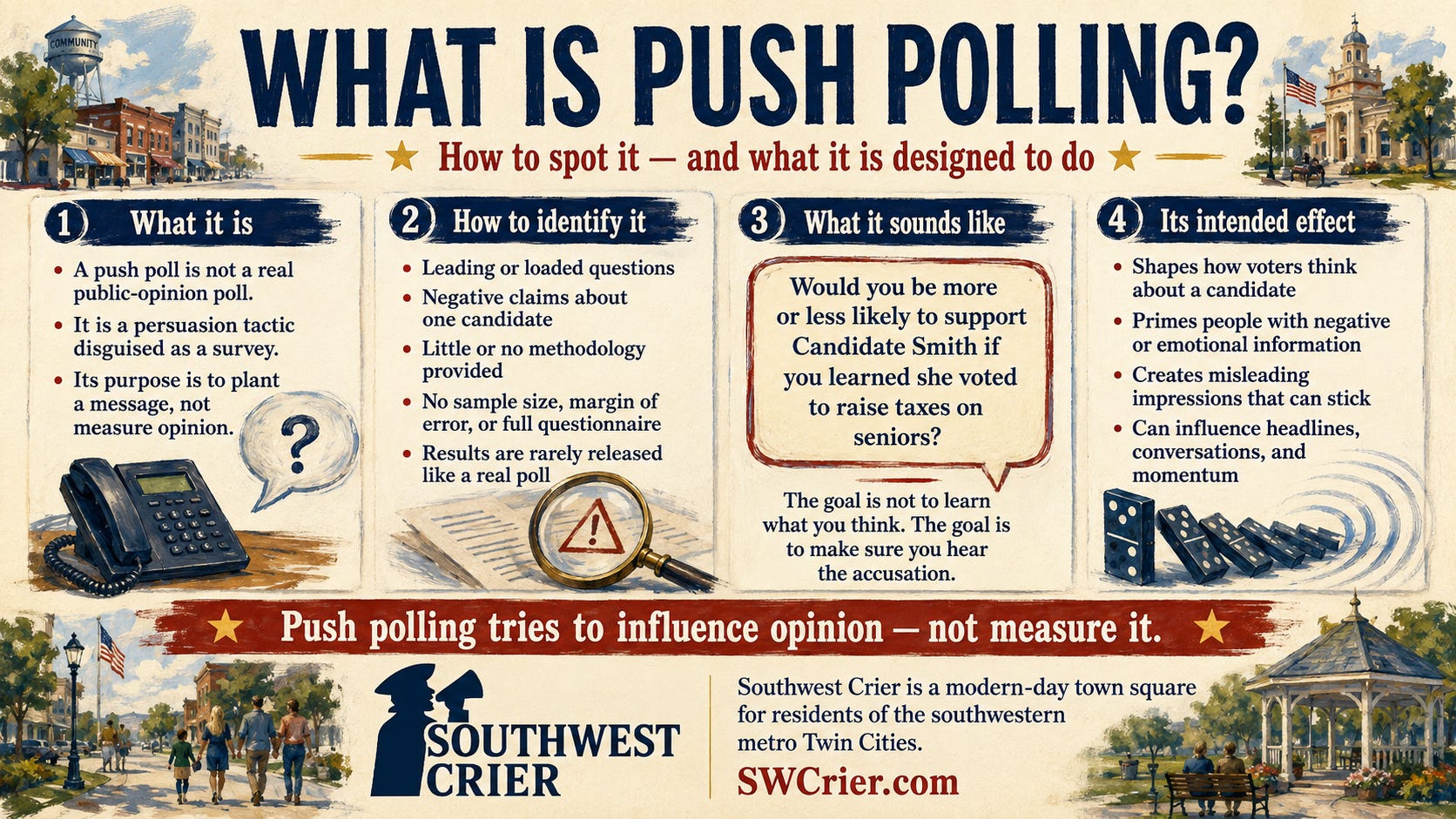
What Is a Push Poll?
Despite the name, a push poll isn’t really a poll at all.
Its primary purpose isn’t to measure public opinion.
It’s to change it.
Imagine receiving a phone call that asks:
“Would you be more or less likely to vote for Candidate Smith if you learned she voted to raise taxes on seniors?”
The caller isn’t simply collecting information.
They’re planting an idea.
Whether the claim is true, misleading, or completely false, you’ve now heard it.
That’s the point.
Push polls often ask a series of emotionally loaded questions about one candidate while asking few (or no) comparable questions about the other. They may never publish results because gathering accurate data was never the objective.
The poll itself is the message.
Why Push Polls Can Work
Human psychology makes push polls surprisingly effective.
Researchers have found that simply hearing a claim—even one that’s later corrected—can make it feel more familiar. Our brains often confuse familiarity with truth.
Other psychological effects come into play as well:
Priming: Certain information becomes more prominent in your thinking.
Framing: The wording of a question changes how people evaluate an issue.
Availability heuristic: Dramatic or memorable claims feel more common than they really are.
That’s why professional pollsters work hard to write neutral questions. Even small wording changes can influence responses.
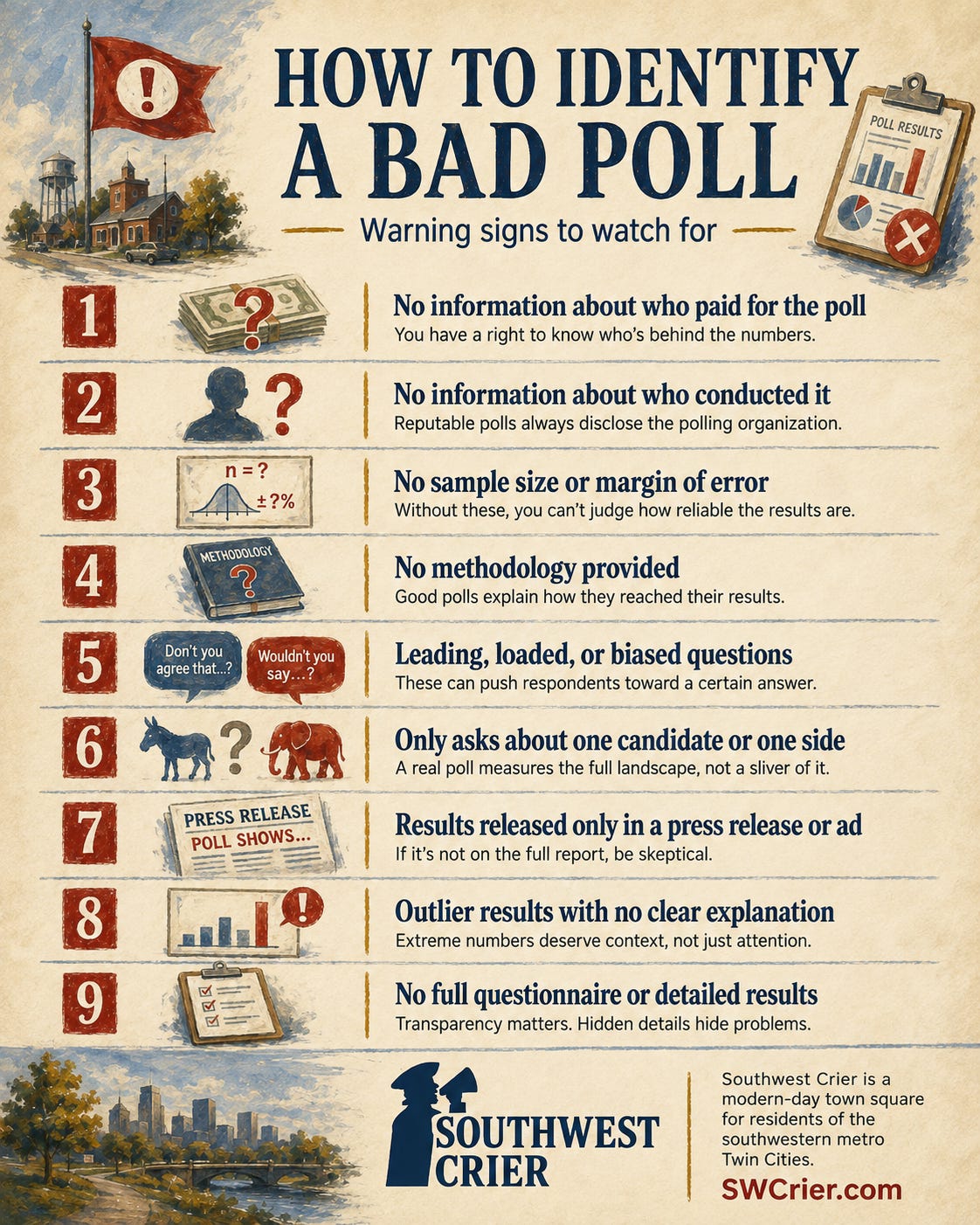
How to Spot a Questionable Poll
Before accepting the results of any poll, ask a few simple questions.
Who paid for it?
Who conducted it?
How many people were interviewed?
When was it conducted?
How were respondents selected?
Was it conducted by live interview, text, online panel, or automated calls?
What’s the margin of error?
Are the complete questions available?
Are the detailed results available?
If none of that information is public, be skeptical. Transparency is one of the hallmarks of quality polling.
Understanding the Margin of Error
One of the most misunderstood numbers in polling is the margin of error.
Suppose a poll finds:
Candidate A: 48%
Candidate B: 46%
Margin of error: ±3%
Many people would conclude Candidate A is ahead. Not necessarily.
Because of the margin of error, Candidate A’s actual support could reasonably be anywhere from 45% to 51%, while Candidate B’s could be anywhere from 43% to 49%.
Those ranges overlap. Statistically speaking, that’s a very close race.
That’s why responsible pollsters rarely describe small leads as definitive.
Why Polls Often Disagree
People are often surprised when two polls conducted around the same time produce different results.
That doesn’t automatically mean one is wrong.
Different organizations may:
Interview different populations.
Define “likely voters” differently.
Weight age, education, race, or geography differently.
Conduct interviews on different days.
Ask questions in different orders.
Each of those decisions can produce slightly different results. That’s why experienced analysts rarely focus on a single poll. They look for patterns across many polls.
Why Polling Averages Matter
Because every poll contains some random error, many organizations publish polling averages rather than relying on a single survey.
This is usually a smart approach.
Imagine asking ten neighbors whether they think tomorrow will be warm. One person’s guess may be off. But averaging many independent opinions often produces a better estimate than relying on just one.
Polling averages work the same way.
When multiple high-quality polls point in the same direction, confidence in the overall trend increases.
When Polling Averages Can Be Misleading
Here’s where things become more complicated.
Polling averages are only as good as the polls included.
Imagine averaging the grades of ten students. If nine scored around 90 but one fake score of 20 is added to the pile, the class average suddenly drops even though nothing changed about the other nine students.
Polling averages can be influenced in a similar way.
If numerous low-quality or heavily partisan polls are released within a short period, they can pull an average in one direction. Whether those polls deserve the same weight as long-established, highly accurate pollsters depends on how the averaging organization builds its model.
Some polling aggregators treat most public polls similarly. Others adjust for pollster quality, historical accuracy, methodology, recency, and each firm’s historical tendency to lean toward one party or the other.
Not all polling averages are created equal.
Fake Polls & Junk Polls
You may have heard last week about a fake poll, the “results” of which spread surprisingly fast across the internet and was widely cited as a credible poll. PBS reports:
Locked in a competitive reelection race, Los Angeles Mayor Karen Bass declared on social media last week that a new poll was evidence that her campaign was “gaining momentum.”
Just a few days later, the truth emerged: The poll was fabricated.
The California results were among at least three “polls” across three states posted online this month by Median Strategies, a previously unknown organization that admitted to the Los Angeles Times on Monday that the purported results were fake. The company wrote before shuttering its website this week that it “was created as a short-term social experiment examining how purported polling information could enter and spread through the political information ecosystem without independent verification.”
In recent election cycles, a growing number of election analysts—including Democratic strategist Simon Rosenberg and election analyst Tom Bonier—have discussed a noticeable increase in Republican-aligned polling firms releasing large numbers of polls late in campaigns.
Rosenberg and Bonier have argued that some of these polls appear intended not only to measure public opinion but also to influence polling averages, media narratives, fundraising, and voter perceptions of momentum.
Polling averages are not magic. They are mathematical summaries of the polls included.
If low-quality polls enter the system, they can influence some averages more than others. That’s one reason many professional analysts evaluate the quality of each poll, not just the topline numbers.
Polls Don’t Predict Elections
Perhaps the most important thing to remember is this: Polls do not predict the future.
They measure what a particular group of people said at one particular moment under one particular set of circumstances.
People change their minds. New events happen. Turnout differs from expectations. Late-deciding voters make choices.
The only poll that ultimately counts is the one conducted on Election Day.
Before You Share a Poll, Ask Yourself…
Before reposting the latest poll on social media, take a moment to ask:
Who paid for it?
Who conducted it?
Is the methodology public?
How large was the sample?
What’s the margin of error?
When was it conducted?
Is it consistent with other reputable polls?
Has the pollster been accurate in previous elections?
Is this poll trying to measure opinion or influence it?
What do multiple high-quality polls say?
You don’t need to be a statistician to become a smarter consumer of polling. You just need to ask a few good questions.
Because in a healthy democracy, understanding the numbers is just as important as knowing the candidates.
Polling Resources
There are a couple of Substacks I follow that regularly address polls and polling.
Lincoln Square - This Lincoln Square interview with Simon Rosenberg is really important for understanding how Republicans are deliberately trying to manipulate public percpetion by polluting polling data.
G.Elliot Morris’ Strength in Numbers - This one is really good if you want to get into the weeds on interpreting polls and understanding the science of polling
Pew Research Center: A premier nonpartisan “fact tank” that studies social issues, public opinion, and demographic trends without doing political candidate “horse-race” polling.
Gallup Poll: The pioneer of modern scientific polling, now focusing on long-term social, economic, and political issues rather than daily elections.
Quinnipiac University Poll: An independent university poll widely respected as a gold standard for tracking voter sentiment on national and state elections and public policy.
Ipsos: A global market research and public opinion firm that frequently partners with major news outlets like ABC News and the Washington Post.
YouGov: A major data analytics and research organization conducting reliable scientific public opinion surveys, often in partnership with CBS News and The Economist.
AP-NORC Center: A collaboration between the Associated Press and the independent research organization NORC at the University of Chicago.
David
Chaska Protests
Every Friday from 3:00–4:00 p.m. at the corner of Chaska Blvd. and Chestnut Street (Highway 41) [Map]
Every Saturday from 1-2 pm at the corner of Hazeltine Boulevard and Highway 41 (Chestnut) [Map]
Chanhassen Protests
Every Saturday: 1st & 3rd Saturdays from 10-11am at Pedestrian Bridge over Highway 5.
Park at Discovery United Methodist Church. We have permission to park there.
2nd, 4th and 5th Saturday from 10-11am at W 78th and Kerber Boulevard.
Sign library is available.
Norwood Young America
Every Sunday, 11 a.m.–12 p.m. (Line up at the bike path south of Highway 212 and Faxon.)
Victoria
Every Wednesday from 4:30-5:30 pm on the corner of Highway 5 and Victoria Drive/County Rd 11.
Waconia
Every Saturday from 11:30-12:30 pm at Highway 5 and County Road 10 in front of the Starbucks and Jersey Mike’s. [Map]
SW Protectors
Every first and third Tuesday from 6:30 – 8:00 pm. It’s no cost and come and go as you like.
Please do buy something to eat or drink, though, to support our venue, which is The Bellows restaurant and it’s located at 232 Pioneer Trail in Chaska.
David this is a great article. Thank you for laying it all out!
Thank you! I wasted time yesterday on a poll that came by text messages that was definitely a push poll. I'll have to read this again carefully to educate myself better.