


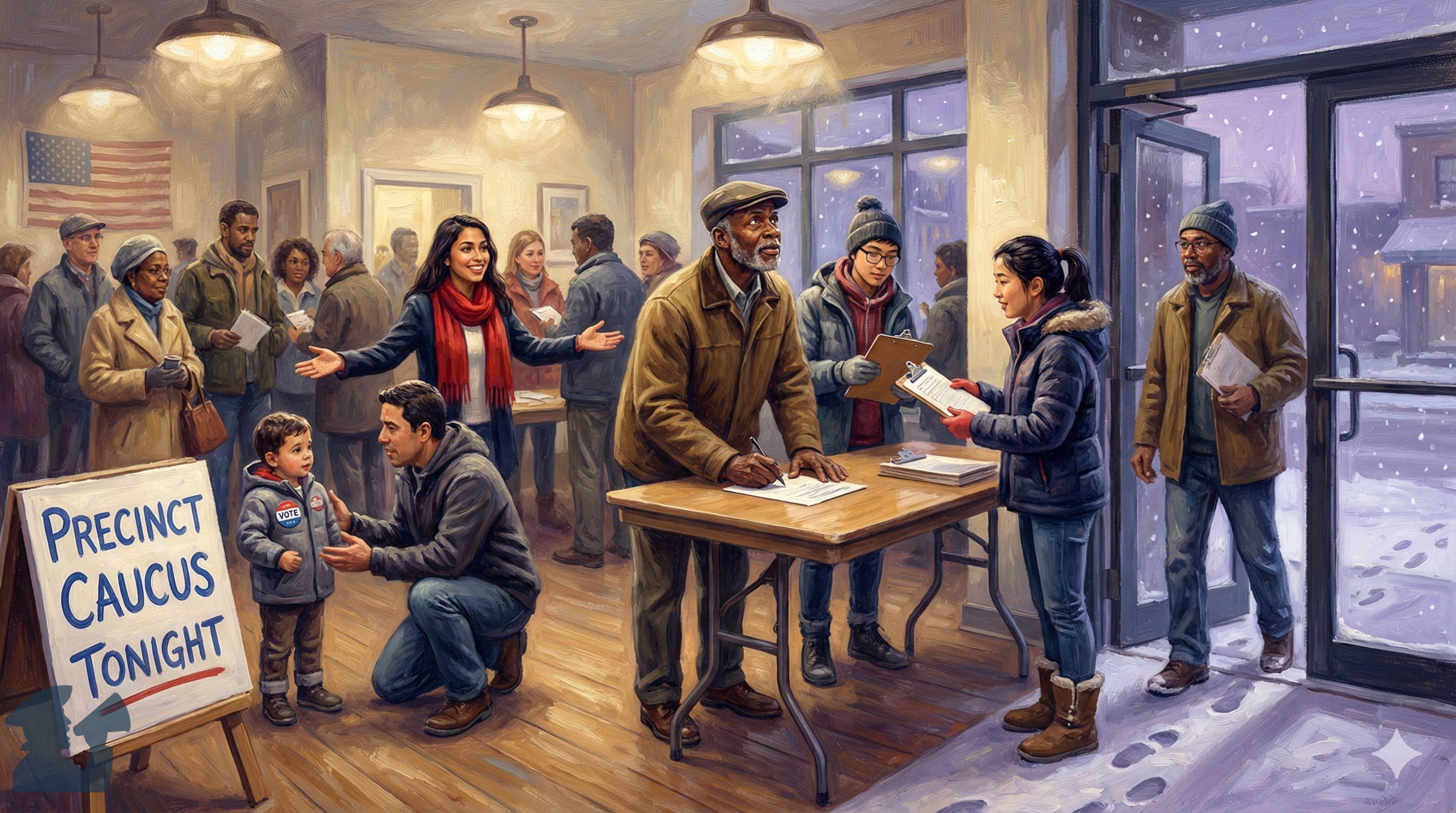
Precinct Caucuses are being held this Tuesday and it is extremely important that we excercise our civic duty to participate.
Our democracy is only as strong as we want it to be; during these dark times we need to add our muscle now more than ever.
If you’ve never attended a caucus before, the process can be a bit confusing so I put together this guide to help you understand it.
This is an excellent opportunity to meet and get to know your likeminded neighbors.
Make connections.
Get contact information.
Form a network of your neighbors for coordination and mutual aid.
David
DFL Precinct Caucuses
Minnesota’s DFL (Democratic-Farmer-Labor) precinct caucuses are neighborhood meetings that serve as the foundational level of the party’s political structure. Unlike a standard primary election administered by the state, these are party-run events where neighbors gather to debate policy and select the people who will eventually endorse candidates for office.
Part I: The Precinct Caucus
The caucus is the entry point for all DFL party business. For the 2026 midterm election cycle, the logistics are as follows:
Date: Tuesday, February 3, 2026
Time: 7:00 PM (Registration typically opens 30 minutes prior)
Location: Neighborhood-specific locations (schools, community centers) that often differ from standard polling places.
Who Can Participate?
To participate, you generally must live in the precinct, be eligible to vote by the next general election (usually 18 by November), and generally agree with the principles of the DFL party. You do not need to be a registered “Democrat” beforehand, as Minnesota does not have partisan voter registration.
The Three Main Functions
While attendees do not cast a direct ballot for a candidate at this meeting, the caucus performs three critical functions:
Electing Delegates: This is the most significant activity. Attendees elect neighbors to become “delegates” to the next level of conventions. These delegates are the only people allowed to vote on endorsements for Governor, U.S. Senate, and the State Legislature at future meetings.
Passing Resolutions: Attendees can introduce and vote on “resolutions”—statements of policy. If a resolution passes at the precinct level, it moves up the ladder and may eventually become part of the official DFL Party Platform.
Electing Precinct Leadership: Neighbors elect a Precinct Chair and Vice-Chair responsible for organizing party efforts (such as Get Out The Vote drives) in that specific neighborhood for the next two years.
The “Walking Sub-Caucus” System
If there are more people wanting to be delegates than there are spots available, the caucus uses a proportional representation system called the “walking sub-caucus.”
Attendees physically group themselves in different parts of the room based on which candidate they support (e.g., “Senate Candidate A,” “Senate Candidate B,” or “Uncommitted”).
Delegates are awarded proportionally based on the size of each group.
This ensures the delegation sent to the next convention accurately reflects the neighborhood’s divided support.
Part II: The Endorsement Process (State Senate)
For a State Senate seat, the endorsement process is a two-step “ladder” that moves from the local precinct up to a district-wide convention.
Step 1: The Precinct Caucus (The Foundation)
The process begins on caucus night. Candidates for State Senate (or their representatives) attend these local meetings to ensure their supporters get elected as Delegates. You cannot simply walk into the future endorsement convention and vote; you must be elected as a delegate at the caucus first.
Step 2: The Senate District Convention (The Main Event)
The actual endorsement takes place at the Senate District Convention, typically held in March or April following the caucus.
Attendees: Only the delegates elected at the February caucuses are permitted to vote.
The Procedure: Candidates are nominated, give speeches, and participate in Q&A sessions. The delegates then cast ballots.
The Drop Rule: If no candidate wins immediately, the candidate with the lowest vote total is usually dropped, and balloting repeats until a winner emerges or a deadlock is declared.
Step 3: The 60% Threshold
The most critical rule in DFL endorsements is the supermajority requirement.
To win the official party endorsement, a candidate generally needs 60% of the delegate vote.
Blocking: If a rival candidate controls 41% of the delegates, they can “block” the endorsement, preventing their opponent from reaching the threshold.
No Endorsement: If the convention deadlocks and no one reaches 60%, the delegates may vote to have “No Endorsement.” In this scenario, the party stays neutral.
Step 4: Endorsement vs. Primary
The Endorsement: If a candidate wins the endorsement, they gain access to party resources (voter data, funds) and the “DFL Endorsed” label. Most candidates pledge to “abide” by the endorsement, meaning they will drop out if they lose the convention vote.
The Primary: If a candidate refuses to abide, or if there is “No Endorsement,” the decision moves to the Primary Election in August. This is a standard public election involving the wider electorate. The winner of the Primary appears on the November ballot, regardless of the party endorsement.
Summary Distinction
It is vital to distinguish between the two voting events:
The Precinct Caucus (February): A public meeting to elect delegates and discuss issues.
The Primary Election (August): A private ballot cast at a polling place to finalize the nominees for the November general election.