


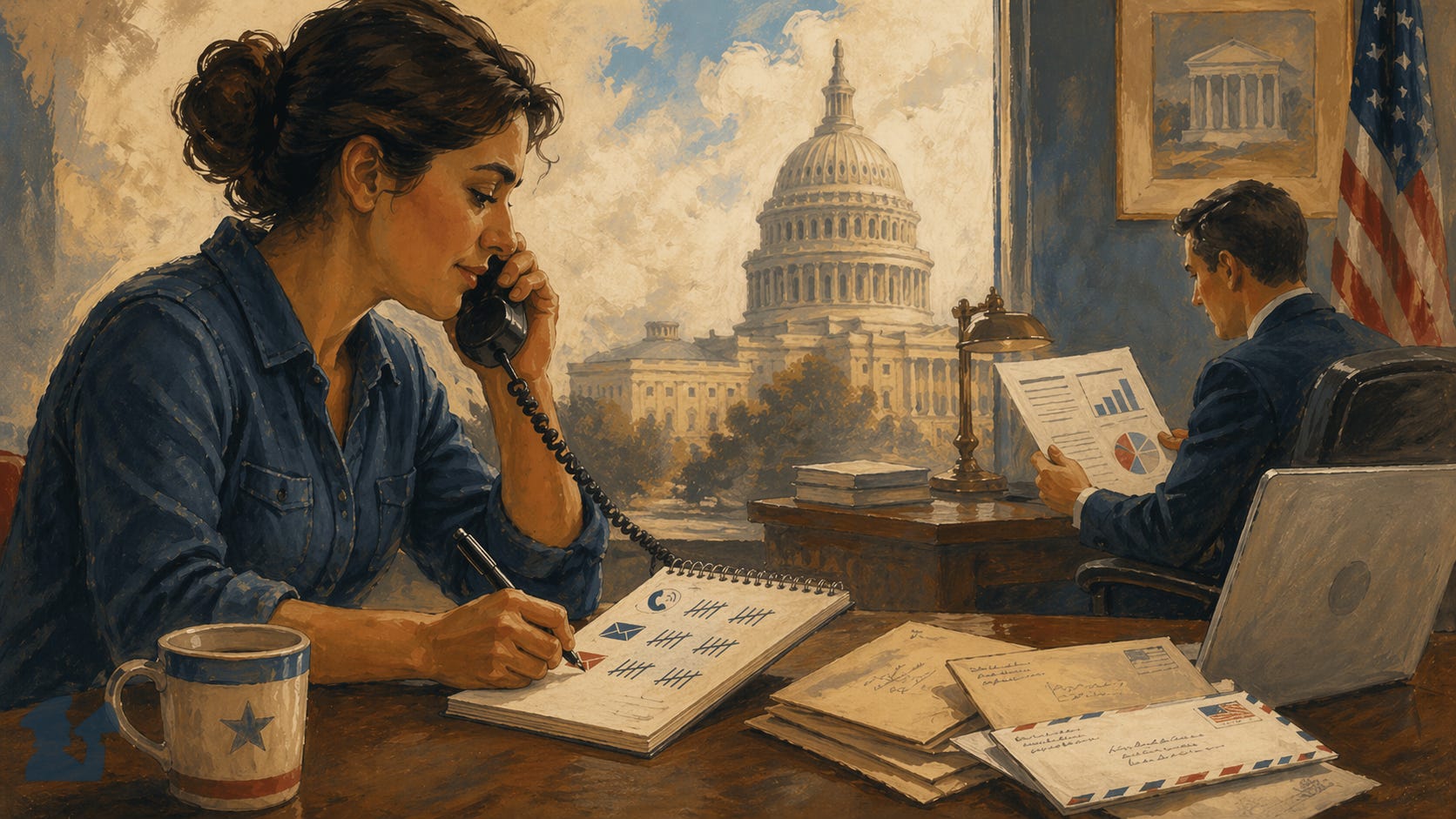
Most of us have seen the instruction floating around social media: “Call your reps, don’t just email.” Maybe you’ve rolled your eyes. Maybe you’ve wondered if it actually matters.
I admit, I’m convinced deep in my bones that Tom Emmer doesn’t give a flying bleep about what I think.
But here’s what’s actually happening inside the building when you do call.
What happens when you call
A staff member picks up. Usually someone junior, working the phones. They ask your name and zip code (they verify you’re actually a constituent), and they log your position on the issue: yes or no, for or against. At the end of the day, those tallies go to the legislative director.
Your senator or representative sees a report. Something like: “47 calls today. 39 against the banking order. 8 in support.”
Volume matters. A spike in calls on a specific issue gets flagged as constituent urgency. It’s one of the few direct pressure signals a member of Congress actually feels in real time.
What happens when you email
It goes into a constituent management system. It gets logged, categorized by topic, and usually generates an auto-response. A staffer may read it. Your position gets counted in a report.
It’s not useless. But it moves slower, carries less weight, and is much easier to deprioritize than a phone that won’t stop ringing.
Why calls hit differently
Calls require a human to pick up or listen to a voicemail every single time. They can’t be filtered or batched the way emails can. A hundred calls in one day on one issue feels different inside an office than a hundred emails. It creates visible, immediate pressure that a staffer has to physically report upward.
That’s the difference between urgency and noise.
You don’t need a speech
This is the part people get stuck on. You don’t need talking points. You don’t need to be articulate. You call, give your name and zip code, and say something like:
“I’m calling to express my opposition to any executive order requiring citizenship verification for bank accounts, and I’d like the Senator to oppose it.”
That’s it. Thirty seconds. They log it and move on. You’ve been counted.
What about writing an actual letter?
Here’s something most people don’t know: a physical letter sent through the U.S. Postal Service carries real weight, arguably more than email and sometimes even more than a call.
It’s slow by design, and that’s the point. A handwritten or printed letter requires deliberate effort. It’s not a click. Staffers know that. A constituent who sat down, wrote something out, addressed an envelope, and mailed it to Washington is a constituent who is serious.
Physical mail also gets handled differently. It’s read. It gets passed around. It sometimes lands on a desk. In high-volume offices during a news cycle, a stack of physical letters on an issue stands out in a way that a filtered email folder does not.
The catch is that mail routed to Capitol Hill goes through an irradiation process for security screening, which can add days or even weeks to delivery. If you’re trying to influence a vote happening next week, a letter won’t get there in time. But for sustained pressure on an ongoing issue, a physical letter is a slow-burning signal that says: this constituent isn’t going away.
When calls and letters arrive together
Here’s where it gets interesting. When an office receives calls on an issue and physical letters on the same issue during the same period, the effect is compounding. The calls create urgency now. The letters are a visual signal that the urgency has been building. Together, they tell a different story than either one alone.
A staffer reporting upward can say: “We’ve been getting calls on this all week, and letters have been coming in too.” That’s not just constituent interest. That’s constituent persistence. It demonstrates that the concern isn’t a reaction to a tweet; it’s something people in the district have been sitting with long enough to put on paper and find a stamp.
For issues that move slowly through Congress, this combination is a pressure tool worth understanding. Use calls when a vote is imminent. Use letters when you want your position on record and want to signal that you’re paying attention over the long haul. Do both when an issue matters enough that you want the office to understand you are not going anywhere.
Who represents you and how to reach them
You live here. You vote here. Your zip code is your standing in that conversation, and it’s the first thing they ask for. Here is exactly where to direct your calls and letters.
U.S. Senate
Senator Amy Klobuchar (D)
Phone: (202) 224-3244
Address: Dirksen Senate Office Building Washington, DC 20510
Senator Tina Smith (D)
Phone: (202) 224-5641 309
Address: 720 Hart Senate Office Building Washington, DC 20510
U.S. House (Southwest Metro)
Most of the Southwest Metro falls within Minnesota’s 2nd, 3rd and 6th Congressional Districts.
Representative Angie Craig (D - 2nd Congressional District)
Phone: (202) 225-2271
Address: 2052 Rayburn House Office Building Washington, DC 20515
Representative Kelly Morrison (D - 3rd Congressional District)
Phone: (202) 225-2871
Address: 1205 Longworth House Office Building Washington, DC 20515
Not sure which district you’re in? Visit house.gov and enter your address. You can also call the U.S. Capitol Switchboard at (202) 224-3121 and they will connect you to any member’s office.
Representative Tom Emmer (F - 6rd Congressional District)
Phone: (202) 225-2331
Address: 326 Cannon House Office Building, Washington, DC 20515
Make the call. Write the letter. Do both.
The people inside those offices are keeping count. Every tally matters, and right now, the count is the whole point.
See you Saturday!
David
Chaska Protests
Every Friday from 3:00–4:00 p.m. at the corner of Chaska Blvd. and Chestnut Street (Highway 41) [Map]
Every Saturday from 1-2 pm at the corner of Hazeltine Boulevard and Highway 41 (Chestnut) [Map]
Chanhassen Protests
Every Saturday from 10-11 am at 7700 Market Boulevard [Map] Public parking is available behind City Hall.
Norwood Young America
Every Sunday, 11 a.m.–12 p.m. (Line up at the bike path south of Highway 212 and Faxon.)
Victoria
Every Wednesday from 4:30-5:30 pm on the corner of Highway 5 and Victoria Drive/County Rd 11.
Waconia
Every Saturday from 11:30-12:30 pm at Highway 5 and County Road 10 in front of the Starbucks and Jersey Mike’s. [Map]
SW Protectors
Every first and third Tuesday from 6:30 – 8:00 pm. It’s no cost and come and go as you like.
Please do buy something to eat or drink, though, to support our venue, which is The Bellows restaurant and it’s located at 232 Pioneer Trail in Chaska.
Thank you! This is important, useful information I can pass on.
Sharon J.
Thank you, David, for breaking down the different impacts of emails, calls, and letters. This is interesting and very helpful!