


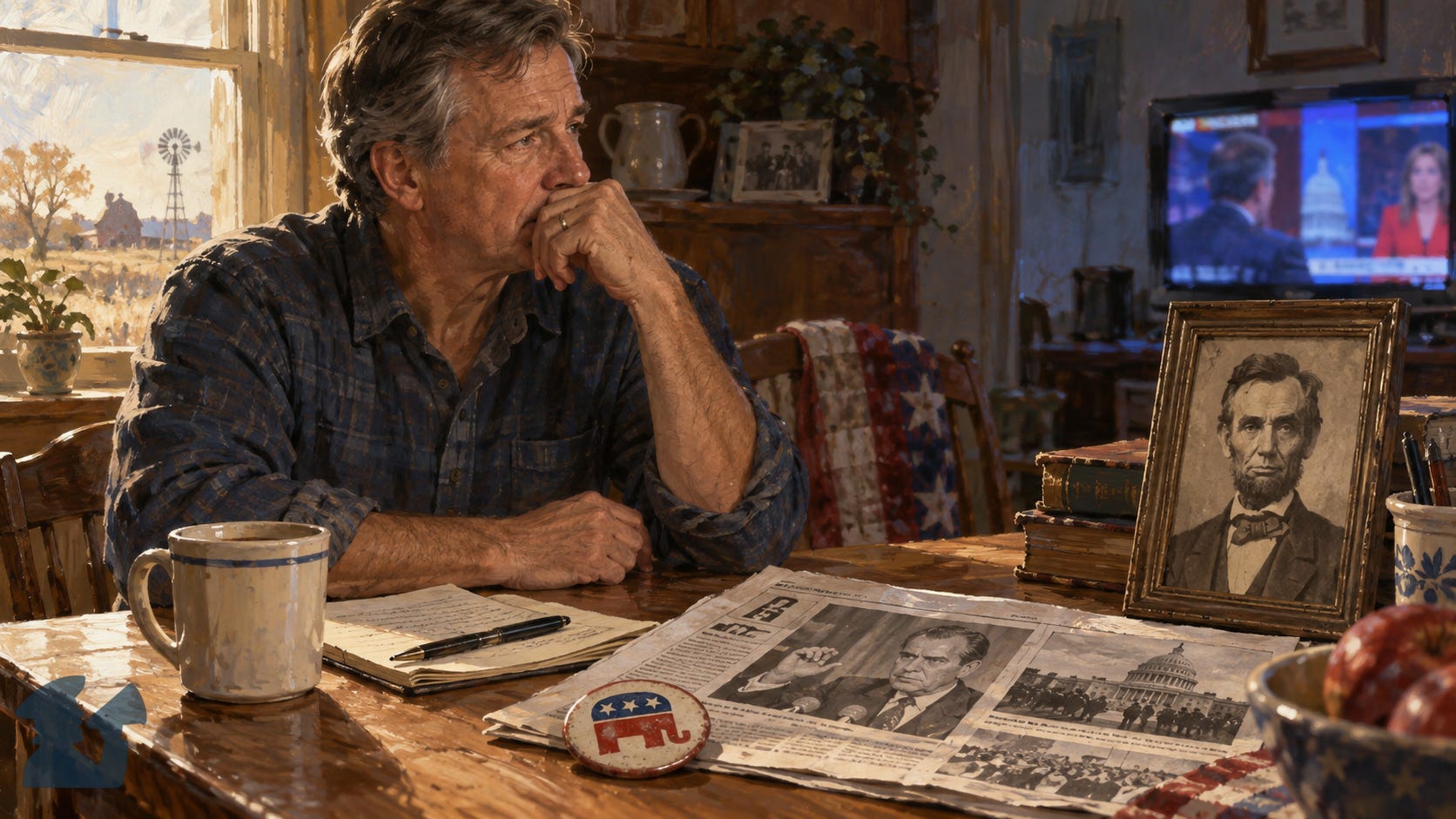
In 1974, Republican senators walked across the White House lawn and told a Republican president his time was up.
Not because Nixon was inconvenient. Because he’d broken the law, obstructed the investigation into it, and the leaders of his own party decided that mattered more than keeping him in office. Barry Goldwater, about as conservative as it got in that era, was one of the men who delivered the message.
That was a version of the Republican Party that would discipline its own president over the rule of law. That version doesn’t exist anymore, and understanding how it disappeared tells you more about where we are than any headline from this week will.
Start further back, though, because the origin story matters..
The Republican Party was founded in 1854 around opposition to slavery and, especially, its expansion into the territories. Not as a minor issue tucked into a broader platform: It was the reason the party existed.
Its first president ended slavery and held the Union together through a civil war that killed roughly two percent of our entire country’s population.
The party that followed him wrote the 13th, 14th, and 15th Amendments into the Constitution. For decades after that, it was, imperfectly but genuinely, the party more associated with civil rights than the opposition.
President Eisenhower sent the 101st Airborne to desegregate Little Rock Central High in 1957. Republican votes were essential to passing the Civil Rights Act of 1964, when a meaningful chunk of Southern Democrats voted against it.
I want that party back. Not because I’m a Republican (never been but at one time I called myself an independent), but because I don’t think American democracy works with only one party that’s still tethered to reality.
We need two parties competing over how to govern, not one party trying to govern and another treating the whole exercise as illegitimate. Right now we have the second thing, and it didn’t happen overnight. It happened through a specific, traceable sequence of decisions, each one making the next one easier.
Nixon’s fall is where the old discipline shows up for the last time. What comes after is the mechanism working in reverse: Each cycle making party loyalty matter more than the thing loyalty is supposed to protect.
Ronald Reagan’s 1980 campaign leaned on the image of a “welfare queen” driving a Cadillac and collecting fraudulent checks under 80 aliases. It wasn’t a real person. It was a composite built to do a specific job: Let voters feel a racial grievance without anyone having to say the racial part out loud.
This is the Southern strategy in practice. It’s a mechanism rather than just a slur, because the mechanism is what kept working long after the specific phrase went stale. Find language that signals “these people are taking what’s yours” to one audience while sounding like neutral policy talk to another, and you’ve built a message that can’t be fact checked. You can’t disprove a dog whistle. That’s the design.
Newt Gingrich pushed the next lever, and this one is more structural than rhetorical. In the early 1990s, Gingrich’s political action committee, GOPAC, distributed a memo to Republican candidates called “Language: A Key Mechanism of Control.”
It suggested specific words to use about opponents: Sick, traitors, corrupt, radical. Not as insults thrown in the heat of a debate. As a deliberate communications strategy, handed down from party leadership, designed to make the idea of a legitimate opposing party feel implausible.
Once your opponents are traitors rather than colleagues with different priorities, compromise stops being a governing tool and starts looking like treason. Congress has never fully recovered the working relationships that framing destroyed.
I’ve spent more than 30 years thinking about media and distribution and I can tell you, none of this scales without an information ecosystem designed to promote it.
Talk radio gave Rush Limbaugh a national platform in the late 1980s, and Limbaugh proved that political grievance, delivered as entertainment, could hold an audience for three hours a day, five days a week. Fox News launched in 1996 promising to be “fair and balanced,” which turned out to mean neither, and didn’t need to, because the actual product wasn’t balance. It was identity confirmation, and identity confirmation is a better retention mechanic than journalism ever was.
In the 90s, I was invited by a conservative friend of mine to a local gathering of Federalist Society members. I remember having a conversation with one of them where I pointed out a weakness in their argument with the line “facts are stubborn things.” To which he replied, “facts are stupid things.” That dismissal struck me at the time and has stayed with me since.
Once that conservative media ecosystem existed, a Republican politician didn’t need to convince a skeptical public anymore. They needed to hold an audience that had already opted into the story.
That’s the infrastructure Donald Trump found waiting for him in 2015. He didn’t build the machine. He just understood, better than anyone who came before him, exactly what it had been built to do.
What Trump and the MAGA movement represent isn’t a policy disagreement with the old Republican Party. It’s something closer to a hostile takeover, using the party’s ballot line and donor infrastructure to run something else entirely: An authoritarian movement wrapped around a financial grift.
Both halves matter, and they reinforce each other. The grift (the fraudulent university, the properties that turned a presidency into a revenue stream, the shell companies, Turning Point USA) keeps the movement funded.
The authoritarianism (the attempt to overturn a lawful election on January 6, the open talk of jailing opponents and deploying troops domestically, the demand for loyalty to one man over loyalty to the Constitution every officeholder swore to protect) keeps it in power. Neither one is the disguise for the other. They’re the same operation, running on two tracks at once.
So the party of Lincoln has been captured. Not by conservatives, whatever you think of conservative policy. By a faction that spent roughly 15 years purging anyone who wouldn’t go along, one primary at a time, until “Republican” stopped describing a set of policy positions and started describing loyalty to a person.
If you used to be a Republican, or still technically are one and you’ve been quietly sick about all of this: I believe you that this isn’t what you signed up for. I think that grief is real and specific, and it deserves more than a lecture about how you should have seen it coming. Most people don’t experience their party’s capture in real time. They experience it the way you experience a slow leak, which is to say they don’t notice until the tire’s already flat.
But I’m not going to pretend there’s a comfortable resolution here, because I don’t think there is one.
A two-party system only functions if both parties are operating inside the same set of facts and the same respect for the rules; otherwise you’re not negotiating policy differences, you’re negotiating with a party that’s decided the referee doesn’t apply to it. You can’t split the difference with an argument that elections are only legitimate when your side wins, or that a federal court’s ruling only counts when it goes your way. There’s no moderate position between “the rule of law applies to everyone” and “it doesn’t.”
Which leads to the uncomfortable conclusion: The path back to a functioning two-party system and a brighter future runs through a decisive loss for this version of the Republican Party, from the bottom of the ballot all the way to the top.
Every officeholder who stayed quiet while the party embraced conspiracy theories and political violence made a choice, whether or not they’d admit to making one. The way a party changes course isn’t an open letter or a primary challenge that gets crushed by 40 points. It’s losses specific enough, large enough, and repeated enough, that staying the course costs more than changing it.
That’s not a call to abandon the two-party system. It’s the opposite. It’s a bet that the only way to get a second, sane, fact-based conservative party back is to make the current version unelectable long enough that something better has room to grow in its place.
I don’t know if I’ll see that happen. But the alternative, a democracy with one party still playing by the rules and one that’s opted out entirely, isn’t a stable equilibrium. Something has to give. I’d rather it be an election than anything worse.
David
Chaska Protests
Every Friday from 3:00–4:00 p.m. at the corner of Chaska Blvd. and Chestnut Street (Highway 41) [Map]
Every Saturday from 1-2 pm at the corner of Hazeltine Boulevard and Highway 41 (Chestnut) [Map]
Chanhassen Protests
Every Saturday: 1st & 3rd Saturdays from 10-11am at Pedestrian Bridge over Highway 5.
Park at Discovery United Methodist Church. We have permission to park there.
2nd, 4th and 5th Saturday from 10-11am at W 78th and Kerber Boulevard.
Sign library is available.
Norwood Young America
Every Sunday, 11 a.m.–12 p.m. (Line up at the bike path south of Highway 212 and Faxon.)
Victoria
Every Wednesday from 4:30-5:30 pm on the corner of Highway 5 and Victoria Drive/County Rd 11.
Waconia
Every Saturday from 11:30-12:30 pm at Highway 5 and County Road 10 in front of the Starbucks and Jersey Mike’s. [Map]
SW Protectors
Every first and third Tuesday from 6:30 – 8:00 pm. It’s no cost and come and go as you like.
Please do buy something to eat or drink, though, to support our venue, which is The Golden Kitchen and is located at 207 N Chestnut Street #110 in Chaska. [Map]
Excellent article!
David, thank you for reminding me about the GOP history.